California’s dwindling teacher supply rattling districts’ nerves

Visalia middle-schoolhouse English language instructor Jennifer Garza says teachers with intern credentials are unfairly criticized.
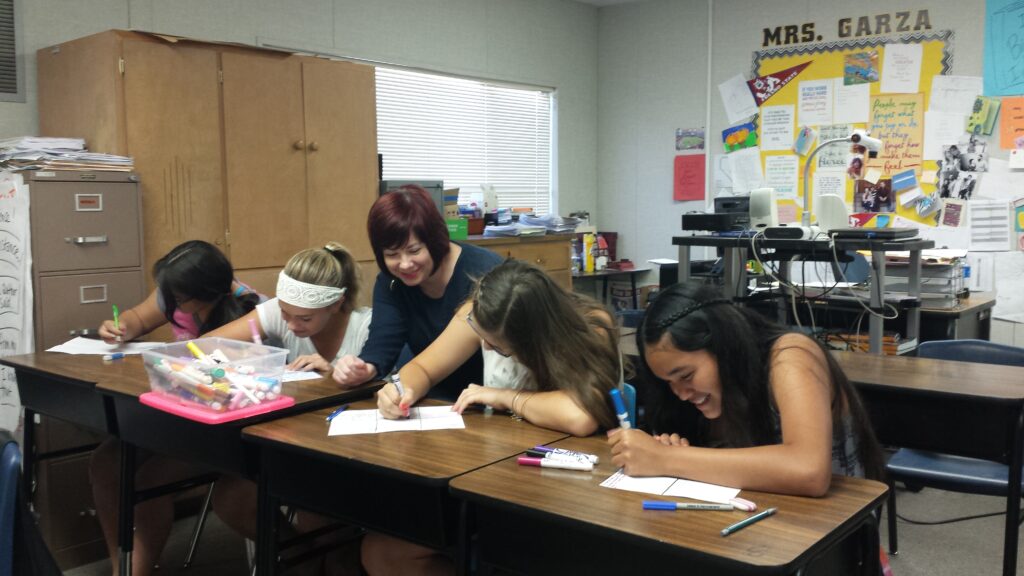
Visalia middle-school English teacher Jennifer Garza says teachers with intern credentials are unfairly criticized.
Just as California school districts are facing new pressures to implement the Mutual Core State Standards and other key educational reforms, many of them are struggling with what some officials are calling the early impacts of a long-feared teacher shortage.
In a common sign of the emerging problem, districts throughout the land have been hiring more teachers with provisional intern credentials – that is, with significantly less training and feel than commonly required. They're besides recruiting more aggressively than in past years. Additionally, some districts are having a harder time finding substitute teachers, every bit more substitutes are finding full-time jobs in a seller's marketplace.
"Are we feeling information technology? Definitely," said Tamara Ravalin, assistant superintendent for human resource development for the Visalia Unified School District, with 32,000 students in the San Joaquin Valley. Ravalin said she was concerned that as fully credentialed teachers get harder to find, the commune volition need to lower its expectations for quality and experience. "If these trends continue, we're going to be in big trouble, considering at that place's just not the aforementioned pool of people as at that place was before," she said.
In a recent series of interviews, human resource officials in six school districts and a statewide charter school system reported a variety of means and degrees to which schools are being affected by a shortage that many predict will worsen. EdSource Today is tracking the six unified districts – Elk Grove, Garden Grove, Fresno, San Jose, Santa Ana and Visalia – and the Aspire Public Schools charter system equally a regular feature of our coverage of the Common Core State Standards.
A range of impacts
The emerging shortage appeared to exist hitting particularly hard in some schools in small, rural districts, and in affluent metropolitan areas such equally San Jose, where housing costs are beyond the reach of most teachers' salaries.

SOURCE: May 2022 presentation by Patrick Shields, executive director of SRI Educational activity; data from California Section of Education and Commission on Teacher Credentialing
From the early 2000s through the recession, the number of new educational activity credentials issued roughly paralleled the decline in estimated numbers of new teachers hired. Simply the lines crossed in 2013-14, and now demand is exceeding supply. The Department of Instruction's estimate of 21,483 new hires in 2015-16 would equal the 2006-07 pre-recession level.
"Small districts accept always had a problem with instructor supply, but at that place's no question the trouble is exacerbated now," said Kevin Gordon, president of Capitol Advisors Group, a lobbying firm that represents the Small Schoolhouse Districts Association. He said an increasingly common emergency tactic for difficult-hit pocket-size schools is to combine two classes of students nether a single instructor. "They make do, but information technology's sure non ideal," he said.
Several of the officials surveyed past EdSource Today said they've been having a particularly hard time finding qualified teachers for math and special education. Notwithstanding others said the crunch hadn't yet hit their districts. Santa Ana Unified Schoolhouse District Superintendent Rick Miller said his district was finding all the fully credentialed teachers it needed, although he added "with so few people in the spigot, things are going to be dramatically different in about 3 years."
By "the spigot," Miller was referring to California's supply of teachers in grooming, which has steadily declined over the by decade. From 2008 to 2013, new enrollments in the land's instruction grooming programs dropped precipitously, past 55 pct.
Potentially further shrinking the country'due south teacher supply are anticipated new retirements, equally increasing numbers of Baby Boomer teachers reach retirement age.
A 2005 report past the Center for Teaching and Learning, role of the nonprofit educational enquiry group WestEd, said that back then about 100,000 teachers in California were more than than fifty years old. The written report predicted that ane-tertiary of the teacher workforce would retire in the next decade – meaning by now. This hasn't happened notwithstanding, possibly because and so many teachers put off retiring during the recession. But the worry remains.
Added to these supply-side difficulties are increasing demands for new teachers. Many districts need to hire more teachers to comply with new state-government pressure to reduce M-3 grade sizes to 24 students. The districts have likewise been receiving big new infusions of state funds due to the surging economic system, allowing them to rehire some teachers who were laid off during the recession, and making the overall market all that more competitive.
A vivid indicator of the growing need for teachers can be seen on the website EdJoin.org, a national educational task board. In June, the total number of posted openings throughout California, the majority of them for teaching jobs, was well-nigh double that for the same appointment in June of 2013, ascension from 5,058 openings to ix,826.
Buyers in a seller's market
Officials in all but i of the six surveyed districts – Santa Ana – said they've been seeking new hires earlier and more aggressively than in the past, planning larger job fairs, strengthening relationships with nearby teaching schools, and even, in some cases, raising salaries.
In Visalia, Ravalin said commune officials raised all teacher salaries past a total of 1.5 percent above the scheduled cost of living increment concluding year, in part to assistance with recruitment. The Visalia district also awards teachers $i,000 for giving aplenty notice before they retire.
Both the Fresno Unified School Commune and the Aspire Public Schools organization have gone then far as to develop their ain teacher-grooming programs in the quest to meet expected hereafter demand. Assisted in part by a grant from the S.D. Bechtel, Jr. Foundation, Fresno established a teacher residency program that last year produced its kickoff accomplice of 25 teachers with credentials in science and math. Cynthia Quintana, Fresno's human resources administrator, said the district is besides creating a new pipeline for credentialed teachers in 3 other ways: with an academy for loftier school students interested in pursuing instruction, an outreach attempt to encourage local parents to consider education careers, and teacher-grooming partnerships with local colleges.
Similarly, Aspire Public Schools has established the Aspire Teacher Residency program, a partnership with the University of the Pacific that pairs a instructor candidate with a master teacher in a year-long tutelage culminating in a master'due south caste in didactics and a preliminary teaching credential.
'They don't know what they're getting into'
Another strong sign of the emerging shortage has come in a contempo statewide uptick in the hiring of teachers with provisional, brusk-term credentials – the bulk of them "interns" from university and district programs. About 2,600 of those credentials were issued throughout California in the 2013-14 school twelvemonth – an increase of 17.6 percent over the previous year, according to an April report past the California Commission on Instructor Credentialing.
Teachers with "intern" credentials may teach classes later a minimum of 120 hours of preparation, on condition that they continue with their training, en route to receiving their preliminary credential inside two years. Subsequently that, they must consummate a teacher-induction plan and obtain national board certification to go their articulate credential.
Whether they come from universities, district credentialing programs, or Teach for America, applicants for such intern credentials must also take earned an undergraduate degree, passed the California Subject area Exam for Teachers (CSET) developed by the California Commission on Instructor Credentialing, and undergone a background check, including fingerprinting.
The districts' reliance on interns has certainly non reached the "crunch" proportions predicted past sources including the California Teachers Association, which warns on its website that California is facing a "perfect storm" of pressures on its instruction ranks, even as it already places last amid states in terms of average student-to-instructor ratios. The country suffered far more serious problems in the late 1990s, later on districts responded to new mandates to reduce K-3 class sizes to 20 students for every teacher by issuing conditional credentials to tens of thousands of teachers. In 2001-02, more than than xiv per centum of teachers had provisional credentials, according to research by Patrick Shields, executive managing director of SRI Education.
Still, Linda Darling-Hammond, chair of the California Committee on Teacher Credentialing, said she worried about the affect on the Common Core implementation if the trend toward hiring relatively inexperienced teachers continues. In particular, she said, experienced math teachers are needed now more always, due to the new standards' accent on deeper understanding of mathematical concepts.
"Hiring teachers who aren't fully credentialed is something nosotros don't allow in medicine or law," Darling-Hammond said. "They're merely not prepared."
In some districts, teachers with intern credentials made upwards a pregnant share of new hires last year. Fresno Unified, for example, the country'southward fourth-largest district with 73,000 students, hired 95 teachers with intern credentials – about a tertiary of its new hires and twice the norm, in response to anticipated retirements combined with a quick stage-in of state-mandated form size reductions in K-3 grades, said Quintana, the district'southward human resource administrator.
Similarly, San Jose will need to hire at to the lowest degree twoscore teachers with intern credentials this September, about a dozen more than for the by school year. Assistant Superintendent Jason Willis said his district's recruiters were having increasing problem hiring special didactics, bilingual and high schoolhouse math teachers.
James Willcox, CEO of Aspire Public Schools, which has 35 schools in California, said he tries to avert hiring teachers with intern credentials but currently has 21 teachers – 3.three per centum of Aspire's teaching force – in that category.
At the Los Angeles Unified School Commune, the largest in California, Bryan Johnson, assistant director of human resources, said the district had hired 350 teachers on provisional credentials, still a tiny fraction of the 25,000-stiff staff. Johnson said his biggest challenges were finding qualified substitutes and special education teachers. Demand for special education teachers is growing, he noted, every bit children with special needs are existence identified in greater numbers than e'er earlier.
The increased hiring of teachers with conditional credentials has raised worries among some commune officials nigh the future quality of pedagogy staffs.
"I'm not maxim that interns tin't walk in and exist great teachers, but we're looking for consistency in performance, and information technology's in the internship where you get the variation," said Santa Ana Unified Schoolhouse District Superintendent Miller. "They don't know what they're getting into and you don't know what yous're getting."
Ravalin, the human resources administrator for the Visalia Unified School District, said she was besides concerned virtually the new teachers' relative inexperience. In many cases, she said, they accept to take over classrooms without having finished their required classes or without preparation alongside a veteran instructor – an experience she described as "condign captain of your ship while yous're nevertheless reading the handbook."
At the Green Acres Center School in Visalia, nonetheless, Jennifer Garza, a one-time industrial saleswoman who teaches 7th-grade English on an intern credential, vigorously disagreed with that portrayal.
Garza best-selling her teaching feel has been difficult, merely said that was just because of how tired she has been from racing from her classroom to grade homework, stop her own homework, staff after-school activities, and attend nighttime classes. That has left her with very little fourth dimension for her two immature children, even less time to residual and a lot of frustration with people who imply that teachers on intern credentials are unqualified.
"It's a very broad argument that I don't recall is truthful," said Garza, who recently completed her second yr of teaching classes while attending nighttime schoolhouse through the Tulare County Office of Education Bear upon intern program.
Similar many other new teachers, Garza spent time – in her example, vi months – as a substitute instructor before taking over her own classroom. Yet as a general dominion, she argued that more than experience alone doesn't brand teachers more skillful. "I've seen some very experienced tenured teachers where I've wondered, 'How is this person yet employed?'" she said.
Moreover, she said she felt more qualified than many veteran teachers to teach the Mutual Core Land Standards because "I didn't have to make a switch. Also, I can attempt out things in the classroom that I've learned the nighttime before."
Her students have appreciated her fresh perspective and energy, Garza said, while she believes their shared experience equally learners gives her an opportunity to model good beliefs: "I've told them how I always get my homework done on time."
To get more reports like this one, click here to sign upwardly for EdSource'southward no-cost daily email on latest developments in pedagogy.
Source: https://edsource.org/2015/californias-dwindling-teacher-supply-rattling-districts-nerves/82805
0 Response to "California’s dwindling teacher supply rattling districts’ nerves"
Post a Comment